Glyn
GlynThere’s a version of the Costa Blanca that has nothing to do with karaoke bars and All-Day Breakfasts. It starts about three kilometres south of Levante beach and keeps going until you’re sitting in a 700-year-old mountain village staring at a notch in a mountain that, according to local legend, was cut by a medieval French knight swinging a magic sword. Here’s why La Cala de Finestrat and Finestrat village belong on every Benidorm itinerary — and why most people miss them entirely.
La Cala de Finestrat — The Beach That Got Away
Benidorm has two famous beaches. What it doesn’t advertise quite so loudly is a third one, tucked around the southern headland where the Old Town meets the water: La Cala de Finestrat. Technically it sits in the municipality of Finestrat rather than Benidorm, which may explain why it’s never quite made it onto the postcards. Their loss.
The cove is crescent-shaped, sheltered by rocky headlands on both sides, and the result is water that’s noticeably calmer and cleaner than Levante or Poniente on a busy day. It’s smaller than the main beaches — this isn’t somewhere you walk for a mile along the waterfront — but that’s entirely the point. The sand is golden, the bay is manageable, and on a summer morning when the main beaches are already filling up, La Cala still has room to breathe.
One practical note worth knowing: La Cala has been smoke-free since 2020. No cigarettes, no vaping, nothing. The fines run to €750 if you’re caught, and the locals take it seriously. For non-smokers it’s a genuine pleasure; for smokers, worth knowing before you unpack the sunbed.
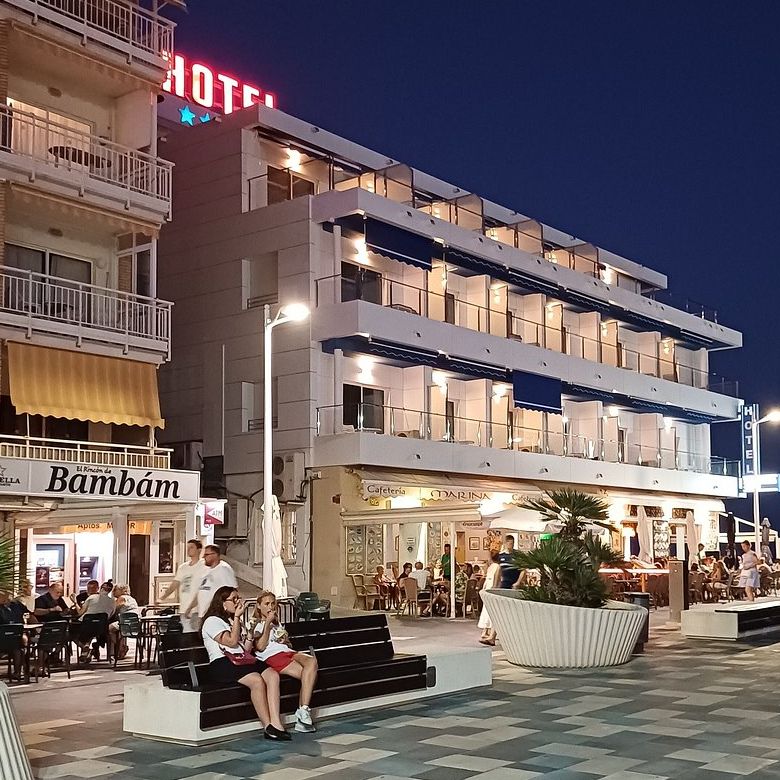
The promenade along the front is a proper one — palm-lined, clean, recently updated — with a string of restaurants and cafés facing the sea. You’re eating paella and fresh fish here, not chips and gravy (though there are one or two English pubs if that’s your thing; this is still Benidorm’s orbit). Taperia Ayala is a solid choice for tapas with a sea view. Ola Blanca is good for coffee and a slow morning. If you’re there on a Tuesday or Saturday, there’s a craft and produce market running alongside the beach — worth a browse even if you’re not buying.
The water activities are all present: kayaking, stand-up paddleboard, snorkelling, pedal boats. The bay’s shape makes it ideal for anyone who finds the open expanse of Levante slightly intimidating — the cove holds the water and keeps the waves down.
The Roman Fort Above the Beach
Most people who visit La Cala look out to sea. Fewer look up. They should.
The hill rising from the right side of the cove — El Tossal de la Cala — is a hundred metres high and carries on its summit the remains of a Roman military fort dating to 77 BC. This was a ‘castellum’, a garrison outpost built by the Roman general Quintus Sertorius during the Sertorian Wars, when rival Roman factions were fighting for control of Hispania. Archaeologists have been excavating here since 2013, and the site is gradually giving up its history.
It’s a short, steep walk up a path from the beach — twenty minutes at a reasonable pace, sturdy shoes advisable. The views from the top are outstanding: the whole sweep of the bay, Benidorm’s skyline to the north, the sea stretching south towards Alicante. The ruins themselves are modest but atmospheric. Standing up there in the heat with a two-thousand-year-old fort at your feet and a packed tourist resort just visible around the headland, you get a pleasing sense of perspective.
Getting to La Cala
La Cala is about three kilometres from Benidorm Old Town — walkable along the coastal path in thirty to forty minutes if the weather’s right, or a short taxi ride (€6–8) if it isn’t. Bus lines 2 and 3 from the centre of Benidorm run regularly and drop you within a few steps of the sand. There’s also parking if you’re driving, which distinguishes it from the main Benidorm beaches where finding a space in August requires either extraordinary luck or extraordinary patience.
Finestrat Village — Twenty Minutes and a World Away
Five kilometres inland from the coast, climbing the lower slopes of Puig Campana, sits Finestrat village. It’s a genuine Spanish mountain village of the sort that tourists imagine exists everywhere in Spain but rarely actually find — because it does still exist here, and somehow it’s stayed that way.
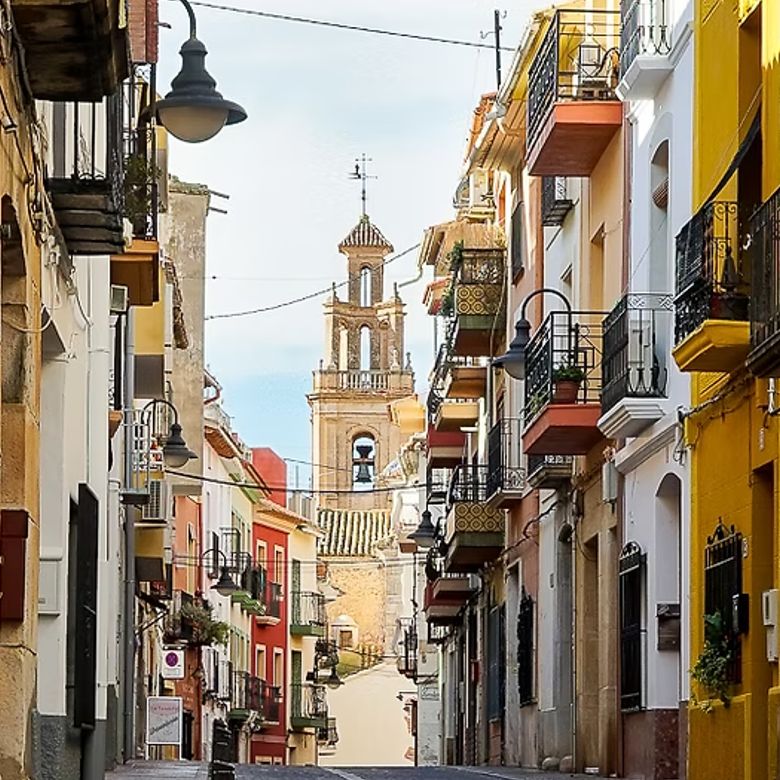
The historic quarter is built on the foundations of an Arab castle dating to the Moorish occupation, and the architecture reflects it. Narrow cobbled streets, whitewashed houses with shutters and flowering balconies, lanes barely wide enough for two people to pass without turning sideways. The origins of the settlement as we know it go back to around 1280, when Christian reconquest brought new settlers to an already ancient site.
There’s no great list of Things To Do in Finestrat village. That’s not really the point. You walk the streets. You sit in the square. You have something cold in a bar that has approximately three tables and no printed menu. You look at the views — and the views from up here are exceptional, the whole coastline laid out below you, Benidorm’s tower blocks rising from the sea like a very specific kind of fever dream, utterly incongruous against the mountains and the blue water behind them.
Guided tours do exist if you’d prefer some context — there are options combining a walking tour of the village with a visit to a local olive farm and tasting, which is not a bad way to spend a morning. But honestly, the village rewards independent wandering just as well.
Puig Campana — The Mountain With a Story
You can’t come to Finestrat and ignore the mountain. Puig Campana dominates the skyline for fifty kilometres in every direction — at 1,406 metres it’s the second highest peak in the Province of Alicante — and it has one immediately distinctive feature: a notch cut clean from the summit ridge, visible from the coast on any clear day.
The notch has a name in Spanish — El Portell, the Gate, or locally El Tajo de Roldán, Roland’s Cut. And Roland brings us to the legend, which is a good one.
The story goes that Roland, the great French knight of the Charlemagne era and subject of the Song of Roland, fought a duel with the Moorish commander on the summit of Puig Campana. During the fight, Roland swung his sword — the legendary Durandal — with such force that he cut a great chunk clean from the mountain. The fragment flew outwards, landed in the sea, and became Benidorm Island. A lesser-known version of the story says the cut was made deliberately, to let the sun set sooner and give a dying companion a final sunset to die by.
The etymology backs the myth up, after a fashion. The name Finestrat comes from the Valencian ‘finestra’, meaning window — and the notch in the mountain above the town is the window that named it.
Puig Campana can be climbed from Finestrat if you’re a confident hiker — it’s a serious mountain, not a casual afternoon stroll, and you should check conditions before attempting it. But even from the village streets below, the view of that notched summit against a blue sky is something you won’t forget quickly.
How to Do Both in a Day
Take a taxi to Finestrat village first thing — the hills are cooler in the morning and the light is better for the views. Walk the old quarter, have coffee in the square, look at the mountain. Ask your driver to take you back via La Cala for lunch. Eat on the seafront, swim in the cove, walk up to the Roman fort if the heat allows. Back to Benidorm by mid-afternoon.
Total taxi cost from most of Benidorm: roughly €30–40 for the day including the La Cala drop. A very reasonable price for what amounts to two entirely different Spains, both within twenty minutes of the hotel.
The Benidorm Bulletin covers the resort most people know — and the bits they don’t. Subscribe free at benidormoldtown.co.uk/newsletter — new issue every Sunday.